Tuesday, January 31, 2006

Priesthood: Privilege or Responsibility


People often defend skewed Bible interpretation or worldly behavior with "the priesthood of the believer." I've challenged people's beliefs and instead of opening their Bible to counter, they claimed priesthood like someone in court pleading the fifth amendment. I have not noticed many thorough or at least precise explanations of the priesthood of the believer. You can relax, because I'm not going to give one in this small space; however, I want us to consider one point together about priesthood. It is not just a privilege, but a responsibility. People raise the privileges of priesthood regularly, but I have heard little to no mention of the responsibilities. When we examine the Old Testament priesthood as a basis of New Testament priesthood, the responsibilities of priesthood far outweigh the privileges. Don't get me wrong, being made a priest by Christ through His death, burial, resurrection, ascension, and intercession is a wonderful privilege (Revelation 1:6; 2 Peter 2:5). I can pray directly to God and study my Bible on my own. Those are wonderful privileges. That doesn't mean, however, that what I think the passage means is actually what it means. Neither does it mean that when we pray, someone shouldn't challenge the prayer.

In the Old Testament, being a priest didn't mean that you could come to God any old way you wanted or even when you wanted. It wasn't like this: "Hey, I'm a priest, and I'll mix my incense like I want." Or, "I'll offer that bullock when I'm good and ready." The priest was heavily regulated with standards. And being a priest was dangerous business for sure, certainly not fun and games. Consider Exodus 28:35, "And it shall be upon Aaron to minister: and his sound shall be heard when he goeth in unto the holy place before the LORD, and when he cometh out, that he die not." And Exodus 30:20: "When they go into the tabernacle of the congregation, they shall wash with water, that they die not; or when they come near to the altar to minister, to burn offering made by fire unto the LORD." And then Numbers 3:4: "Nadab and Abihu died before the LORD, when they offered strange fire before the LORD." Not taking responsibility could be punishable by death. There was a whole lot to do and to get it done took considerable effort and dedication.

The New Testament priesthood is the same in the way of responsibility. It is a holy priesthood, not common or profane. The priest goes to God, but he also represents God before men. He must accurately represent God to men. His offerings to God should be precise. When Nadab and Abihu offered something of their own desires, but different than what God required, God killed them. People might think or say: "I'm my own priest, so I can give Him whatever I think He would want from me. Or at least no one can stop me." The church's setting of standards under guidance of church leadership can protect a church full of priests from being profane in either its offerings to God or its representation of God. God is still serious about what we give Him. What a privilege it is to serve Him and draw near to Him, but also what a serious responsibility.

Monday, January 30, 2006

Fundamentalist: The Movement or the Adjective?

Do any of you that believe the Bible think you trace your lineage of faith back to the early 20th century? the early 16th century? the early 4th century? What about the early 1st century? I'm happy to trace my faith back to the Lord Jesus Christ and the Bible. I don't believe in a total apostasy for three reasons: (1) The Lord said the gates of hell would not prevail against His church (Mt. 16:18), (2) Paul wrote that "some" would depart from the faith, not everyone (1 Tim. 4:1), and that (3) the total apostasy wouldn't occur until the antichrist had revealed himself (2 Thess. 2:3,4). I don't need some tangible extra-scriptural written history to believe that true NT churches have existed since Christ, but even so, we also have sufficient evidence providentially preserved that corroborates this point. These churches operated separately from Romanism and were known by different names, however, essentially having the same Scriptural distinctives. Therefore, I am happy to identify with these people, the Baptists, as my lineage.

In my opinion, fundamentalism was nothing other than an interdenominational movement in reaction to institutional liberalism. The definition in Webster's unabridged backs my understanding, when it reads: "a movement in American Protestantism that arose in the early part of the 20th century in reactin to modernism and that stresses the infallibility of the Bible. . . " Bible believing and practicing churches also rejected liberalism, whether fundamentalist or not, so would have been at least sympathetic with fundamentalism. These same churches also agreed with what have been called "the five fundamentals of the faith." These churches, though, never ever took the five fundamentals solely as their standard for separation or unity. They also rejected infant sprinkling and a host of other doctrines held by the fundamentalist movement.

Men are responsible to allign with everything God said in His Word (John 14:15-22). Agreeing to follow everything the Lord said fits into a proper view of repentance (Romans 10:9, 10; Deuteronomy 30:11-14). Making disciples requires "teaching them to observe all things" that Christ commanded. Paul exhorted Timothy that he "mightest charge some that they teach no other doctrine" (1 Timothy 1:3). Paul also wrote in Romans 16:17, "Mark them which cause divisions and offences contrary to the doctrine which ye have learned; and avoid them."

I like the third definition of fundamentalism in Webster's Unabridged: "Strict adherence to any set of basic ideas or principles." I am not a fundamentalist of the movement, but I am a fundamentalist used as an adjective, in fitting with strict adherence to everything the Bible teaches. For that reason, I don't mind someone calling me a fundamentalist. I don't trace any lineage to the beginnings of the fundamentalist movement. If someone transported our church to that period, I wouldn't fellowship with those fundamentalists. I would have sympathized with them like I do with Ian Paisley, for instance, in the matter of perfect preservation of Scripture, but without fellowshipping with him due to his views on infant sprinkling (among other doctrines). I don't take my stand on fundamentals. I take my stand based upon the Word of God. When we stand before Christ, that's all that will matter.

Saturday, January 28, 2006

Extremists


In a recent interview about his film about the tragic terrorist murder of Israeli athletes during the 72 Munich Olympics, Steven Spielberg says, "It saddens me to see how narrow-minded and dogmatic some of the right-wing fundamentalists here in the USA are. . . .I do not claim to be providing a peace plan for the Middle East with my film. But is that a reason to leave it all to the great simplifiers? Jewish extremists and Palestinian extremists who to this day regard any form of negotiated solution in the Middle East as some kind of betrayal?" Is it possible he's right, that the best path for peace between Palistinian Jews and Arabs would be at negotiating table? Is there no dogmatic solution?

Liberal Jews (and all other liberals) don't accept Scripture, including the Old Testament, literally, that is, grammatically and historically. Since they reject Scripture, except as some kind of allegorical moral self-help book, they make decisions based on pragmatic and subjective human reasoning, not rooted in any objective truth. Because of this, they think that all sorts of behavior should be justified and tolerated. This leads to this search to understand the possible justification of an act of terrorism, leading to a kind of moral equivalence between the murdered and the murderers.

Joshua, Saul, David, and Solomon, for instance, could and did know that God wanted them to expel all the Canaanites from the land, primarily through military conquest. By the time that era of Palestinian history was complete, instead of doing what God said, Israel attempted to do exactly what modern day Israel is trying to do, live together in harmony with diverse cultures, relinquishing the purity that God demanded, as well as His protection. Peace comes from agreement upon and the enforcement of God's revealed Truth. If God wishes Israel to take and keep all the land and expel everyone else, then that is the way of peace. Because the Arab side says that they deserve the land, or part of it, doesn't mean they do. If Israel is supposed to have and keep it all, then she should, even if it means ejecting anyone from her land that doesn't agree. Someone may call that extremist, but that doesn't make it so.

This last week, Oprah used an entire show to slam an author she had recommended for her book club for making up (lying about) major features of his non-fiction self-help book. What does it matter whether one needs to take it literally as long as it helps people? And what is the truth? Can anyone really decide that? Oprah says her standard is truth, so she was betrayed by this author. Is Oprah an extremist? Since truth is relative to what works, shouldn't we just say that this author told the truth to the people he helped? The truth about God and God's Truth about everything, the Bible, is even more important. If believing it and practicing it makes someone an extremist in the temporal world, but a victor with God and in eternity, then so be it.

Friday, January 27, 2006

Where Sin Gets Defeated


When I was a kid, which I usually also add, "it wasn't so long ago," a comedian named Flip Wilson made famous the phrase, "The Devil made me do it." The Devil maybe had something to do with it, but we know he didn't make us, because sin originates in our own lusts. "[E]very man is tempted, when he is drawn away of his own lust, and enticed" (James 1:14). Sin starts with a desire that we have in our flesh in which dwelleth no good thing (Romans 7:16). From there it moves to the realm of enticement. Where are we enticed? Answer: In our minds. Our desires in our flesh interact with our mind, our mind send messages to our flesh, and these two have a relationship. The next verse of James 1 says then that lust "conceive[s], and bringeth forth sin" (v. 15). After finishing the sequence of sin, James commands, "Do not err, my beloved brethren" (v. 16).

James 1:16 states how sin gets defeated. You ask, "It does? Do not err? How does that say anything?" An expanded understanding of "do not err" is "Stop being deceived." James commands believers to stop being deceived because deception takes place in the mind. That deception is called enticement in v. 14. The sequence is like the worm on a fishing hook. The fish sees the worm and thinks it's supper, but it's actually a hook. The fish is deceived in its little mind. The mind is the place where sin gets defeated. To do so, we must train our minds to discern the bait, the counterfeit. We do that by feeding it with God's Truth. Scripture is replete with this very truth, that renewing our mind with the Word of God is the basis of keeping from sin (Psalm 119:9,11; 2 Corinthians 10:5; Philippians 4:8; Romans 12:2). When our mind is filled up with the Truth, it will stop sin from conceiving. Enticement ends when our mind tells us that we are dealing with a counterfeit. It's not a worm; it's really a hook. In a sense, all of us need to prohibit conception--the conception of sin in the mind--by training our mind to think Biblical thoughts.

Thursday, January 26, 2006

Diminished Value and Shuffleboard Syndrome


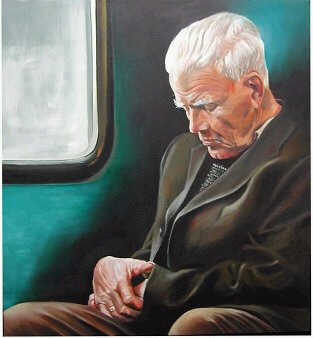
I've noticed that I cry about birth and death and then things closely related. The happiness in the face of the mother with her newborn brings tears to my eyes. The death of someone, almost anyone, mists me up. When I think about someone's death because of a lingering illness or risky surgery, my throat constricts. Have you sat somewhere that you could watch the responses of an elderly person to the verve and vigor of young people, a lifetime of moments etched into the wrinkles? While you consider this, I want us to think together about two issues of old age, both relating to a culture that has veered off course.

Number one I'll call "diminished value." The population does not respect the elderly as they should. I believe that every reason is wrong, because Scripture commands: "Thou shalt rise up before the hoary head, and honour the face of the old man" (Leviticus 19:32). Among the explanations, however, are (1) Misplaced admiration of physical strength and youthful beauty, (2) Personal discomfort with old age foibles and fragility, (3) Lack of marketability in bulges, bunions, baldness, and bifocals, and (4) Prideful youth not put in its place. The pressure of these among others makes older people feel of little value to worthless, a bother. I recognize that certain carnal features of the elderly highlight these reasons, namely things like: complaining, constant retelling of old stories already memorized, moping over lost strength and stamina, and regular lectures repeated way too many times. We need to show the older folks more respect and give them responsibilities fitting of their station in life.

Number two I'll call "shuffleboard syndrome." The notion of retirement, not found in Scripture, has lead to a lack of involvement from the elderly that, coupled with increasing disrespect, has taken them way out of the equation in church and society. Older people start planning to do their own thing as a sort of repay for the years of shouldering burdens. Because of how people view the world today, they excuse a lack of involvement from the hoary heads. "These people deserve a break, not just today, but this year or even the next decade." Experience alone doesn't mean wisdom, but they have contributions and many times in the way of wise counsel for decision making. Their perspective, at least, is worth considering.

I guess at some point I won't be saying "they," so let's get it changed before we become the "they," and for their sake and ours, but mostly for the Lord.

Wednesday, January 25, 2006

The End Justifies the Means


While recuperating from battle wounds in 1521, a Spanish soldier named Ignatius Loyola dedicated his life to Roman Catholicism and the pope. In 1540, the pope gave Loyola approval to begin a new religious organization called the Society of Jesus, or Jesuits, as a part of the Counter-Reformation. They purposed to maintain and reclaim members and spread the doctrine of Romanism all over the world by any manner necessary. They initiated a philosophy encapsulated by the phrase, "the end justifies the means," which became their hallmark.

Three questions guide anyone's life: What, Why, and How? What am I going to do? My Actions. Why Am I going to do it? My Motives. How Am I Going to Do It? My Methods. To know God's will, we apply Scripture to every question. The Jesuits obviously did wrong things, unscriptural actions. However, in their frame of reference, they thought they were right, especially because their motive was to please Romanism and the pope. However, they didn't care how they got it done, because that didn't matter. So many people disregard scriptural methodology, reasoning that it doesn't matter how you do what you do, as long as you reach a scriptural or desired result. So much of Scripture contradicts this by either teaching a method or punishing a wrong method. 2 Samuel 6 and the example of Uzzah and the ark of the covenant jumps out to illustrate this point. Bringing the ark to Jerusalem was the right action with the right motive. Carrying it on a cart was the wrong method. Uzzah died as a result. The sufficiency of Scripture demands that we use scriptural methods. When those methods are utilized, God gets the glory, not only the overarching motive, but also the central activity of the Bible. If only the end justifies the means, then we are no better than Loyola and his Jesuits. And that might be the least of our problems.

Tuesday, January 24, 2006

Spirituality


Owen Waters writes: "The frequency of your inner self’s consciousness exists within a frequency band which is higher than your outer self. When your conscious mind catches even a glimpse of that spiritual essence within you, it becomes excited by the higher frequency. Communicating with your inner self is, by definition, an exhilarating process." Groovy. Far out, man. I googled these exact words---"a very spiritual person"---and got 25, 600 sites. I believe one of if not the most dangerous influences is a false definition or wrong understanding of spirituality. God is a Spirit (John 4:24) and Satan wants us confused about Who He is and how we come into and then stay in fellowship with Him. False spirituality preys on those who are discontent with their own spiritual experience. They want to feel approval from God in a very subjective way. They look for a personal, unique, and validating connection with God.

To fool people about spirituality, Satan uses some of his long proven devices, ones that have already deceived millions of people in Hinduism and Buddhism, essentially Eastern mysticism. Satan provides these feelings and experiences wholesale in the new age movement, mind science cults, psychics, and psychiatry. In a lesser but perhaps more deceptive fashion, they have woven their way into the Charismatic movement and now evangelicalism at large. They have saturated Roman Catholicism for centuries and today even more. They lie at the root of Mormonism and its "burning of the bosom." In varying degrees, they shift spirituality away from objective truth. This is philosophical existentialism, the reality validated by the experience. It must exist because I felt it.

I'm very concerned about the dangers to New Testament Christianity, even as already evidenced through a multitude of practices in churches. Churches create a "spiritual environment" either through fast paced music that will get people excited or through hypnotic new age choruses and "praise songs," among others. Here's the kind of statement one might hear: People want to be done with the fighting and feeling the unity of the spirit between believers, putting aside our differences to find common ground and a blessed intimacy with one another. Not that particular words are necessarily wrong in themselves, but these are the code words that I am most often hearing in the new paradigm of spirituality: passion, desire, intimacy, encounter, deep, vital, rich, warmth, evoke, intense, delight, affection, ardent, deep-hearted, celebration, and energize. Now consider these, not all, but some or one or all: outstretched palms, breathy or soft speech, tambourine, lots of emotion and lack of negativity. Even though they talk about a desire for God, the point is the desire, not God Himself.

The truth is that we have all of God at the moment of salvation and all of our spirituality (2 Peter 1:1-5; Eph. 1:3; Rom. 8:9). God desires us, all of us. When we know Him better through His Word, through His Truth by faith, then we obey Him and submit to Him more. Spirituality doesn't minimize externals to gain some sort of superior spirituality based on feelings. The greatest in His kingdom is the one who keeps the least of His commandments (Mt. 5:19). Spirituality manifests itself in tangible character traits, including bold evangelism, submission to authority, and abstaining from fleshly lusts. People may not "feel spiritual" when they are doing these things, but when they keep doing them out of respect for God, that, folks, is spiritual. Satan the spirit being, wants to dumb spirituality down to something in which many different cultures and beliefs have common ground in their shared experiences, to replace true spirituality with his own.

Monday, January 23, 2006

We Really Did Know


You've seen those fake arrows that are meant to fool no one. They are not supposed to look like they are really sticking through someone's head. They're a joke. We really do know that they are fake. There are a lot of things that we are actually able to know. When we don't, it is only us to blame.

Israel, the ten northern tribes, were doing things that would result in this: "Therefore the LORD shall set up the adversaries ... against him, and join his enemies together; ... and they shall devour Israel with open mouth. For all this his anger is not turned away, but his hand is stretched out still" (Isaiah 9:11, 12). Being devoured sounds pretty serious to me. God wants them devoured for something they have done. As you consider why, I want you to consider what in particular is wrong with what they were doing. The people of Israel were saying, "The bricks are fallen down, but we will build with hewn stones: the sycomores are cut down, but we will change them into cedars" (Isaiah 9:10). Alright, now tell me what verse says that rebuilding walls with hewn stones is a sin. Can't think of one? Thought so. What about the second? What verse of Scripture says that when sycomores are cut down, it is really bad to replant cedar trees? Can't think of one again? Thought so again. So what was wrong? If the Bible doesn't say something is wrong, does that mean that it won't be wrong? We see here that this is not so. It can be wrong. Rebuilding and replanting with superior rocks and trees are not the problem, but they are both indicators of self-sufficient pride, which is wrong.

People may say, "I didn't know that would be wrong to do." They knew. If they didn't know, they should have known. God doesn't devour people, and especially His own people, for doing things that they couldn't have known were right or wrong. People often argue that certain activities must be right because God doesn't expressly say anything against them. Much of what God prohibits, He expresses in the way of principle. He knows we can understand those principles and make decisions that will honor Him based upon them. When we don't follow the principles, and, therefore, disobey God, we won't be able to say that He didn't tell us it was wrong, because we really did know.