Tuesday, March 14, 2006

Baptism of the Spirit

John the Baptist prophesied in Matthew 3:11, "I indeed baptize you with water unto repentance: but he that cometh after me is mightier than I, whose shoes I am not worthy to bear: he shall baptize you with the Holy Ghost." This is consistent with the parallel passages in Mark, Luke, John, and Acts. Let's look at the Acts passage, for instance: "For John truly baptized with water; but ye shall be baptized with the Holy Ghost not many days hence" (Acts 1:5). Alright, so the baptism of the Spirit is being prophesied in the Gospels. To know what fulfillment we are to look for, we should consider those predictions. They provide the model for Spirit baptism. Who is the Administrator of this baptism? It is Jesus, the one whose shoes John was not worthy to bear. Jesus is the Administrator of Spirit Baptism. What is the element of the baptism? It is the Holy Spirit. The Holy Spirit is the Medium of Spirit Baptism. Who are the recipients of the baptism? They are already saved people. "You" is plural in Matthew 3, something you can't specifically see in the English. The plural "you" are people already saved and in certain cases, already baptized, saved people. So Spirit baptism according to the model is subsequent to, not simultaneous with salvation. That's what we should look for.

When we look at the fulfillment in Acts 2, that's what we see. Consider Acts 2:1-4a: "And when the day of Pentecost was fully come, they were all with one accord in one place. And suddenly there came a sound from heaven as of a rushing mighty wind, and it filled all the house where they were sitting. And there appeared unto them cloven tongues like as of fire, and it sat upon each of them. And they were all filled with the Holy Ghost." Who are these "they" mentioned? We must go back to the previous chapter, and we see that these were already saved people, already born again individuals, essentially the church at Jerusalem, even already baptized, who were then baptized with the Spirit on the Day of Pentecost. The element of the baptism was the Holy Spirit. We know that Jesus Christ sent the Holy Spirit, outpoured or sent Him on or to believers there in Jerusalem (John 15:26; 16:7). So, by looking at the prediction and the fulfillment, we get the model of Spirit baptism, and we are sure that Jesus is the Administrator, already saved people are the recipients, and the Holy Spirit is the Element or Medium.

Many, many professing believers and all "reformed" Christians believe that 1 Corinthians 12:13 teaches Spirit baptism. Let's find out if 1 Corinthians 12:13 fits the model predicted and fulfilled in the Gospels and Acts. This passage buttresses their belief in the universal, invisible church or the invisible body of Christ. Here's what it says: "For by one Spirit are we all baptized into one body, whether we be Jews or Gentiles, whether we be bond or free; and have been all made to drink into one Spirit." If this is Spirit baptism and not water baptism, it ought to fit the model. OK, first, Who is the Administrator of baptism here? The Holy Spirit. Well, zero for one, so far. Well, let's try a second, Who is the Medium of the baptism here? Hmmmmm, the body of Christ, so Jesus is the Medium or Element. Well, now we're zero for two. What about the recipients? We surely must get that right, especially with so much scholarship represented that takes this view. The reformed say that Spirit baptism is simultaneous with salvation, not subsequent, and the Spirit places us in the body of Christ. Hmmmm. So simultaneous with salvation, not already saved people, but people at the moment they are getting saved. Zero for three. Nothing in 1 Corinthians 12:13 says that this is Spirit baptism. What the passage does teach is that already saved people are water baptized into the body of Christ. Their baptism pictures their unity within the body. The body is a local church (see v. 27). Much more evidence exists contextually to say this is water baptism, immersion in deep, wet water.

Just a little theological snack to chomp on for now.

Monday, March 13, 2006

Where Are the Words?

I wrote this as a post on SharperIron, and it was so much work, I thought I’d double up and put it here too.

I think the original questions were (cut and pasted): "The thing that still plauges my understanding of all this is...did God promise to preserve EVERY word or not? If so, then where are they?"

I did not read the replies super carefully, so you can correct me if I'm wrong, but I didn't actually read an answer or answers to his questions. I'm not counting "read so and so's book" as an answer. That would mean we've gone four pages of text, including some very, very long posts without giving him an answer. Perhaps we forgot the questions or we just don't like them. They are good basic questions, and obvious ones too. On every single doctrine, I start with: "What does the Bible teach?" I never start with: "What do famous 'fundamentalists' say?" Or, "What does history tell me?" When someone starts with the latter questions, they reveal a historico-rationale apologetic.

Answer to first question. Yes, he did promise to preserve every word. The Bible teaches this clearly, at least as plainly as it teaches inspiration. I guess I should assume that you want to know where the Bible teaches that. You will find a Biblical theology for the perfect preservation of Scripture cumulatively from Matthew 5:17-19 (especially v. 18), 4:4; 24:35; Isaiah 59:21; Psalm 12:6,7; and 1 Peter 1:23-25, among other places. This bibliology is also taught through the perfect passive of grapho (it is written). As well, inspiration implies preservation. Someone who agrees wrote in 1984: "Inspiration ensures the preservation of God's words regardless of the destruction of individual texts by wicked men." He was none other than Dr. Mark Minnick, and wrote this in the 1984 Biblical Viewpoint, Focus on Jeremiah. The renouned liberal, Bart Erhman, The University of North Carolina at Chapel Hill, once a conservative theologian and confessing born again, writing in his most recent book on textual criticism and giving testimony to his watershed moment, said, "I kept reverting to my basic question: how does it help us to say that the Bible is the inerrant word of God if in fact we don't have the words that God inerrantly inspired, but only the words copied by scribes---sometimes correctly but sometimes (many times!) incorrectly? What good is it to say that the autographs (i.e., the originals) were inspired? We don't have the originals!" Sounds familiar, doesn't it?

Answer to the Second Question. Another doctrine within the framework of preservation of every Word of God is availability. God also promised availability of every Word. That is a doctrine I have assumed as I read Scripture, because it smacks of the plain reading of the Bible. Deuteronomy 30:11-14, Matthew 4:4; John 12:48; 2 Peter 3:2; Jude 1:17, and Isaiah 59:21, among others, cumulatively express this teaching. If God says they will be available, then we would assume that we would know which ones they are. How do we determine that? Scripture teaches us, for one, in the doctrine of canonicity. The Bible teaches a canonicity of Words, not books. The church (generic singular), that is, churches have agreed on the words, like they agreed on the books. God uses the church as His pillar and ground for the truth, and since the Holy Spirit works through churches, we look to see what He did. People have believed they had a perfect Bible. The London Baptist Confession has an identical wording as this in the Westminster Confession of Faith: "The Old Testament in Hebrew (which was the native language of the people of God of old), and the New Testament in Greek (which at the time of the writing of it was most generally known to the nations), being immediately inspired by God, and by his singular care and providence kept pure in all ages." That is what churches had believed, believed, and still believe. That statement in the confessions was chiefly revised hundreds of years later by Benjamin Warfield, a Presbyterian at Princeton Seminary. He understood that the modern view of textual criticism didn't fit with the Biblical doctrine of preservation, so he spun the confession into textual criticism. Many have just taken Warfield's position as historical. I think is one good reason why to put quotes around the word history. I have taught history for 15 years and I will often say "history."

What words did the churches agree upon? They agreed on the King James Version. Someone says, "But that's English!" Sure, but there are Greek words behind the King James Version, and today that is published in Scrivener's 1894 and Trinitarian's TR. They are essentially found in Beza's 1598. The Bible doesn't say they'll be available in one Greek edition. It says they will be available. Some might not like that answer, but the alternative is rejecting the doctrine of preservation and availability, and please don't tell me either the "preserved in heaven" view or what I call the "buried text" view. The book mentioned, God's Word in Our Hands, says that God preserved His Word and that the Words are in all of the manuscripts. Of course, first, all of those words aren't available, and, second, that book doesn't even agree by the admission of the authors, at least privately, that they don't believe that their thesis is even true. They believe certain parts of the Old Testament Hebrew are still not found or don't even exist in a preserved form. They use the "Greek Septuagint" to back translate into the Hebrew to correct the Masoretic text. These are the same people who have a problem with preservation in a translation. Doesn't sound consistent, does it? The KJV and the text behind it was received by the churches for at least 350 years. To say those were not the words is to say that the Bible wasn't preserved and wasn't available. I reject that view based on the teaching of Scripture, just like I reject evolution based on the teaching of Scripture. I've never seen a worldwide flood or the ark, but I accept the Genesis account of the flood. I accept that I have every word, and I believe there was a miracle of preservation that matched a miracle of inspiration. Quoting Ehrman again in his trek toward liberalism, he wrote: "The fact that we don't have the words surely must show, I reasoned, that he did not preserve them for us. And if he didn't perform that miracle, there seemed to be no reason to think that he performed the earlier miracle of inspiring those words." Too bad, isn't it?

One more thing, Dr. Sproul's book has a "review" of our book, Thou Shalt Keep Them, in the addendum. That chapter is actually a total hatchet job written by the same Dr. Gephart. Dr. Gephart, incidentally, uses Bruce Metzger to provide almost half his chapter in God's Word in Our Hands (an ironic title). Bart Ehrman calls Metzger his "father-professor" in his book. It isn't coincidental that Metzger taught at Princeton Seminary, where Ehrman attended, and also the school of Benjamin Warfield. Connect the dots: Warfield...Metzger...Ehrman and Gephart. Actually, it's all very sad. He really doesn't argue away the points, just takes pot shots, and very poor ones. He wants to discredit the exegesis enough to cause reasonable doubt, like a defense lawyer attacking the prosecution. I wish I could say differently, but that's what he does. It doesn't read like someone who wants the truth of those passages. What else I have noticed is that they offer no alternative. What do we get when they're done? Doubt in the Word of God.

Sunday, March 12, 2006

The "As Long As It Doesn't Hurt Somebody Else" Argument


John Donne, 17th Century English poet, wrote: "No man is an island, entire of itself; every man is a piece of the continent, a part of the main. If a clod be washed away by the sea, Europe is the less, as well as if a promontory were, as well as if a manor of thy friend's or of thine own were: any man's death diminishes me, because I am involved in mankind." He, yes, originated the "no man is an island" quotation, so that is not in the Bible, but I think the jist of it was already in Romans 14:7, which says, "For none of us liveth to himself, and no man dieth to himself." What spurred this train of thought was a conversation I had with a lady in our church this morning. She takes care of her fifty-four year old son and right now he's in the hospital. I asked her how the hospital care was going because I knew she had trouble before. She chronicled the lack of attention, missed medications, and then even an attemped double dosage. I mentioned that these types of things occur more and will only get worse because people's morality really does impact other people.

"As long as it doesn't hurt somebody else" has become the creed in a new morality. When the Supreme Court recently ruled against a Texas sodomy law and for that very reason, they validated this new paradigm of justice. A common abortion argument is: "A woman should have the right to her own body, so as long as she doesn't hurt anybody else, the state should allow her an abortion of her fetus." For this to work, of course, the "mass of tissue" must be a fetus. If it is a person, then I guess someone else really is getting hurt. Setting that argument aside, however, I ask if we do have a basis for arguing on behalf of laws of morality because each of these immoral acts does impact somebody else. What do I mean? The immoral acts strike at the value of life itself. The more people devalue life, the worse the private and public service we will have. Life erodes away under the disrespect it receives.

I believe that a lack of reverence for the 8th commandment, thou shalt not steal, results in the eminent domain thievery of people's private property. The estimated financial gain of a city is more important than one person's right to his own property. You see, immorality ultimately does come back to get us. It's not so bad shopping at the new downtown redevelopment as long as it doesn't mean making grandma move from her childhood home. Can you say nostalgic value? I know you can't measure that on Wall Street. And grandma only votes one time.

Speaking of islands, the Tasmanian devil, named after its island home doesn't live or die to itself. At least the wallabie doesn't think so, as the devil devours it bones, fur, and all with very powerful jaws. Devilish really. Every creature in the God-ordained food chain affects one another with its "personal decisions." Every egg you crack certainly impacts the poulty farmer. We can't hardly move without making a ripple somewhere with what we do, so that all the things we do really do impact someone else and then even who knows who all else. What they did in Florida to Terry Schiavo when they unhooked her feeding tubes could become you and no one will even care. Allowing that kind of disrespect of life could very easily affect your hospital care next time you go in for kidney stones. Better be sure they don't take the appendix. Devilish really.

Friday, March 10, 2006

Temples


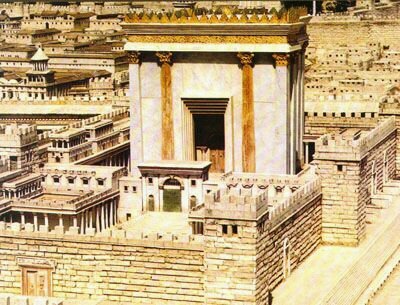
The temple takes a prominent place in history. We have the tabernacle in the wilderness, replaced by Solomon's temple (957BC), destroyed in 587BC, Zerubbabel's temple (520BC), destroyed in 19BC, and then Herod's temple (19BC), destroyed in AD70. In the future, the Antichrist will build a temple in the tribulation period, which will be desecrated by him (Revelation 11:1, 2) and destroyed along with almost everything else, and finally the Lord Jesus Christ Himself will superintend the building of the Millennial Kingdom temple (Ezekiel 40-47). When you think about all this, you see this big chunk of time where the temple essentially existed 957BC to AD70. We have to see the continuity between the tabernacle in the wilderness and the temple, making this an even longer period of time (c. 1440BC to AD70). And then in the future, two temples will measure over another one thousand years of history.

What is the temple exactly? Let's think of two points: (1) The place of the presence of God, and (2) the place of the worship of God. The temple is a place where God comes to dwell on earth with His people. God prescribed congregational worship with the temple as the center. He regulated the worship with specific prescriptions in His Law. We can see that a large gap appears in the temple history after AD70 and before the tribulation period. Is there a temple in this period?

The temple today is the church, local and visible, just like Old Testament Israel. This temple replaced the one in Jerusalem. God ended OT temple worship when He rent the veil of Herod's temple in Jerusalem at the death of the Lord Jesus Christ. The Lord Jesus Christ prophesied (Matthew 24:1, 2) the end of that temple with the destruction by Titus in AD70. Paul tells the Corinthian church in 1 Corinthians 3:16, "Know ye not that ye are the temple of God, and that the Spirit of God dwelleth in you?" In that text we point blank find that the church, local, is the temple of God. It makes sense when you consider John 1:14. "And the Word was made flesh, and dwelt among us, (and we beheld his glory, the glory as of the only begotten of the Father,) full of grace and truth." "Dwelt" here is literally, "tabernacled." The place of the presence of Christ is the new tabernacle or temple. The Lord Jesus Christ gathered an assembly of men around Him, dwelling among them. The church (local only) is the body of Christ (1 Cor. 12:27). He dwelt in His temple with His physical presence and He gave His Spirit to that small congregation around Him in John 20:22. When He ascended to heaven, that small group was still indwelt by the Holy Spirit, Himself God, until the Holy Spirit was outpoured on all those who believed on the day of Pentecost (Acts 2).

Worship in the day in which we live is where both the Holy Spirit dwells (1 Cor. 3:16) and where Christ Himself dwells (Rev. 1:19-2:1). That is only the local church. Of course, every believer is also the temple of the Holy Ghost (1 Corinthians 6:19, 20), but corporately, that place is the church. God has prescribed the place of God's presence and the place of worship, His Temple, and it is the church, the one where God's people congregate.

Thursday, March 09, 2006

The Dialectic Three-Step


The German philosopher Hegel introduced dialectic thinking in the early 19th Century. In his philosophy, one idea, the thesis, works against a contradictory one, the antithesis, to create something brand new, the synthesis. The synthesis becomes a new thesis and the process starts all over again. The process trashes objective truth and welcomes subjectivity. Hegel's little three-step encouraged revolutionary nationalism throughout Europe, justifying conflict as a means to an end. The end was fascist or communist dictatorship, the Nazis and the Soviets, and over a hundred million killed.

Does Hegel still impact today? Sure. This is how the three-step typically looks now: "Our diversity brings together people from different religions and philosophies and points of view, finding the best from everyone of them to borrow and share and form a beautiful and strong mosaic." Somehow this sounds good and appeals to fallen flesh and human pride, but it is less than a dream, certainly not true. The United States originated with the idea that diverse people from varied backgrounds and locales could live together, but with only one culture. Their way of life was founded upon a Judeo-Christian ethic anchored in the absolute truths of Scripture. Without certain and steadfast beliefs, life becomes a grand Hegelian experiment, never truly knowing what will work or what is best. Of course, this fundamentally dismisses God as some figment of imagination no better than a character in a Homerian tragedy. Without the sufficient guidance of the Word of God, man wanders aimlessly toward ruin. God created us, gave us His authentic guidelines, confirmed and corroborated them with evidence, and called on us to do what He says. Success requires rejecting any antithesis.

Interestingly enough, dialecticism stops in several very suspecting places, including in the science classroom. The evolutionist doesn't welcome the antithesis of creationism. Suddenly purity of belief makes sense to a professor whose livelihood depends on the continuation of a hoax. Stalin had no dreams of any antithesis to his own meglomanic world, like so many other politicians who begin enjoying power. A grammatical and historical interpretation of the Bible can't be added to a public school system and a strict view of the constitution doesn't mix with a living, progressing document. For Satan, it never was an enjoyment of diversity, just a conspiracy against God and Truth, leaving man forever damned with him in eternal oblivion.

Wednesday, March 08, 2006

More About How to Pray


We left off the model for prayer provided by Jesus Himself with "Our Father." You know what's next: "which art in heaven." This isn't to differentiate Him from any earthly Father or to detail His location. This implies His nature, power, height, and domain. He sees everything, can do anything, and knows all things. The words show respect to Him, not approaching Him flippantly. "Dear Heavenly Father" works the same as long as we aren't saying the words mindlessly.

Next: "Hallowed be thy name." Remember that we are asking God for things. Here was ask Him to be praised. We hallow His name by separating Him unto His most basic character. He is hallowed in contrast with profaned. Hallowing separates Him to His rightful place of majesty---sovereignty, power, honor, holiness, greatness, and more. His name associates with His nature or essential character. We praise God in His attributes, both transient and intransient. The transient are those which we can possess---love, mercy, longsuffering, gentleness, etc. The intransient do not transfer to men---omnipotence, omniscience, omnipresence, immutability, etc. Praise differs from thanks in that praise focuses on God's nature rather than things He has done for us. If you don't know what to say in praise to Him, then look at the psalms. They are full of great praise phrases to direct towards the Father in Heaven.

Nowhere in the model does it tell us to give thanks. This is the point in the prayer where I do that. I like to place it at the front, right after praise, mainly because of Psalm 100:4: "Enter into his gates with thanksgiving, and into his courts with praise: be thankful unto him, and bless his name. " We thank Him by counting our blessings, naming them one by one. When you do that, it becomes difficult to see God as anything but a good God. I have long thought that the Lord does more things for us at any one time that we cannot keep up with thanks. That gives us plenty to thank Him for. I usually divide my thanks into two categories: spiritual and physical. Spiritual: Jesus' substitutionary death and sacrificially shed blood, the Holy Spirit, the Bible, the church, our own salvation, discernment, and more. Physical: air, food, water, our house, our family. Just visualize His creation and thank Him for the sun, heat, light, grass, oceans, rivers, and just keep on naming them. Again I ask, and it sounds something like this: "I ask that You would receive thanks for the great blessings You have provided, for....."

When we open the prayer with this praise and thanks, it gives us the right perspective for prayer, focusing on Him rather than what we want. We are more likely to pray in His will when we consider everything in the light of Who He is and what He has done for us. Our faith is also strengthened to believe in some answers by means of the concentration on how Great He really is.

Tuesday, March 07, 2006

What About Singing Psalms?


Colossians 3:16 and Ephesians 5:19 both mention a direct result of Spirit-filling and letting the Word of Christ dwell in us richly: Singing Psalms. Before the late 19th century, most New Testament churches sang psalms, some exclusively. Were they doing something that we are missing?

In worship, we direct our music to God. What does He want to hear from us? He gave us 150 psalms, so obviously psalms. Then in the NT, in the rare texts on music, He first asks for psalms. It isn't an alphabetical order---psalms, hymns, and spiritual songs. At the least, it is a prioritization. He most wants psalms. So why have psalms been almost eliminated from churches today? Could it be that we have stopped evaluating our worship from a God-centered perspective? People got tired of singing psalms, too difficult for them to consider and often accompanied by music unappealing to human flesh. Is that a suitable criterium for stopping something God expressly told us He desired from us?

How do people sing from psalms? A few good psalters still exist. They contain all 150 psalms with tunes befitting their inspiration and grandeur. The old Metropolitan Tabernacle hymnbook of Spurgeon in London contained its own psalter. That church still sings those same psalms. The Trinity Hymnbook, Baptist Edition contains its own psalter. You can purchase other psalters which are excellent renditions, versifying (putting into rhyme) every word of the Hebrew Masoretic Old Testament text into English. Often accompanying the psalms are majestic compositions of music that conform to their lofty message.

So if you or your church aren't singing the psalms, then why not?

Monday, March 06, 2006

The Way to Pray


I'm guessing you've heard of parents who washed their kids' mouths out with soap. Still in the military the enlisted approach officers with saluting respect. Children ought to talk to their mom and dad a certain way. But more than anything, we ought to talk to God like He has told us. Personally, I have often felt in need of guidance in going to God in prayer. What could we say to Him that He would want to hear, that would even respect and love Him enough? Not one of us need to guess on this. The Lord told us exactly how we are to pray in answer to a point blank request from His disciples in Luke 11: "Lord, teach us to pray, as John also taught his disciples" (Lk. 11:1). If you care about talking to God, and you should, then you also are interested in how God wants us to pray to Him. As clear as the teaching of the Lord Jesus Christ is, I still hear very few people who follow His model. Who could know more about what the Father wants to hear, than His Son. Who could be better on this subject? Obviously, no one. Let's think about this text together.

In v. 1, He starts: "When ye pray." Prayer technically is asking. His model is one of asking. When He says, "When ye pray," that means, "When ye ask." We don't go to God demanding, but requesting. For that reason, when I pray, I begin everything with a request. This is a way that we respect God and His sovereignty. Some might think this is a little picky, but shouldn't we be about prayer? We require a certain manner of speaking to communicate respect. As we go to God, going with requests gives Him that respect. So even when I begin praise, I ask God to be praised. We leave it up to God whether to accept our prayers. He has promised He would, but that doesn't mean we should try to tell Him what to do. Here's an example of the verbiage: "Dear Father, I ask that You would be praised, glorified, lifted up to Your rightful place of power and might and wisdom and honor."

Do you ever hear people start their prayers like this: "Dear Jesus" or even "Dear Lord"? Jesus tells His disciples, "When ye pray, say, Our Father." The Lord Jesus tells us to direct our prayers to the Father. The Scriptural model is not talking to the Son or the Holy Spirit. Several songs published in hymnbooks contain prayers directed to the Holy Spirit. That doesn't even please the Holy Spirit, let alone God the Father. All Scripture came from the Holy Spirit, so He told us to pray to the Father in Luke 11 as well. I couldn't guarantee you that God hears prayers of those who direct them at the wrong Person in the Godhead. Why not regulate your personal worship of the Lord through prayer by what He said, instead of by your feelings or opinions? Direct your prayers to the Father.